

The history of Hayti
Our mission
Hayti Heritage Center exists to gather, preserve, and propel Black culture — creating spaces where artists can create without apology, and serve as a bridge for communities to connect. Through intentional, multifaceted programming, Hayti serves as Durham's living cultural memory: rooted in legacy, animated by the present, and oriented toward a future that centers and supports its creators.

Our history
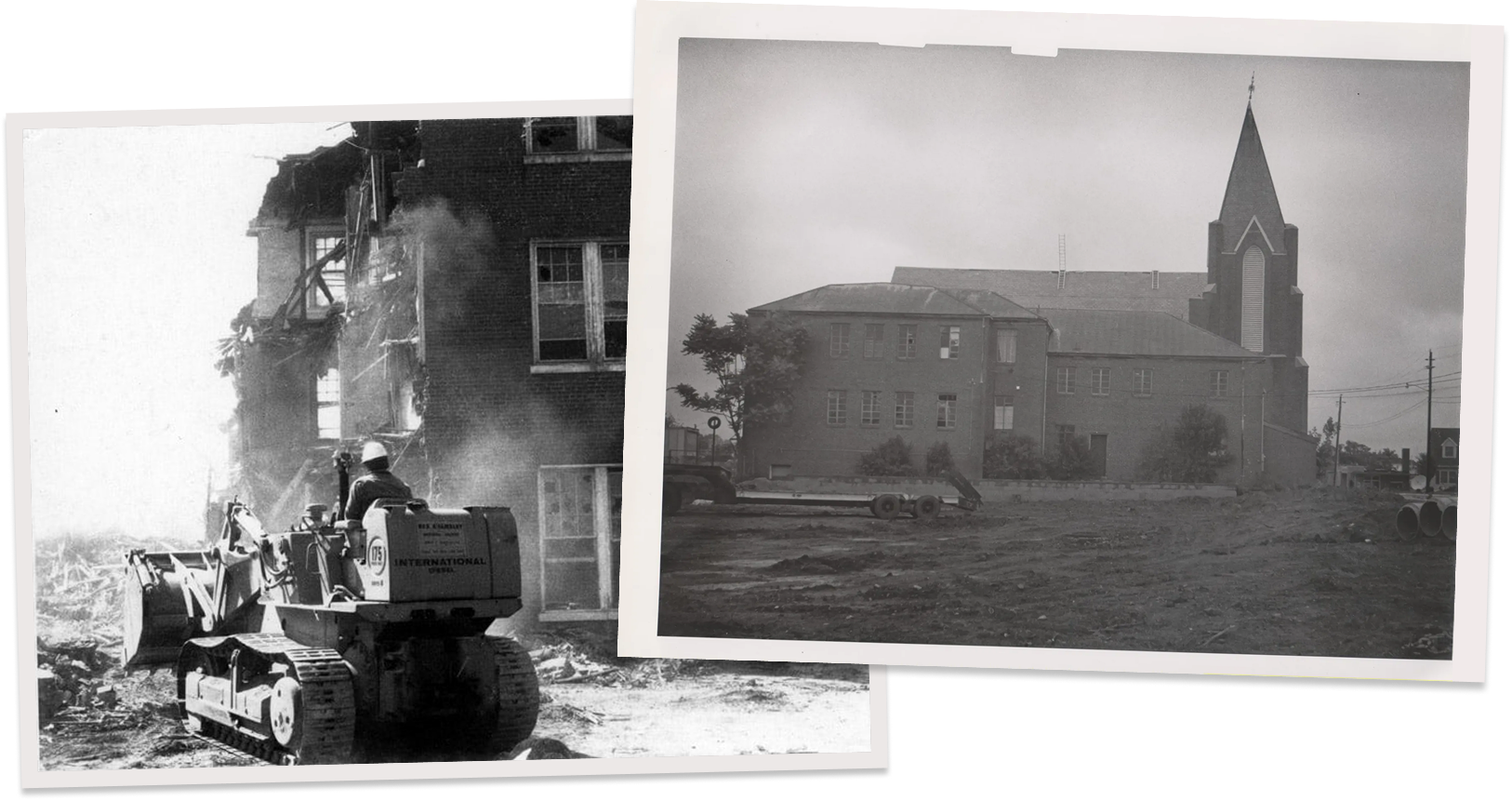
A century ago, Hayti wasn't just a neighborhood; it was a working economy. A place where Black families turned faith, education, and entrepreneurship into institutions and wealth, passed down, hand to hand, across generations. That economy was disrupted when the Durham Freeway cut straight through the district's center. But the story didn't end there.
The Hayti District
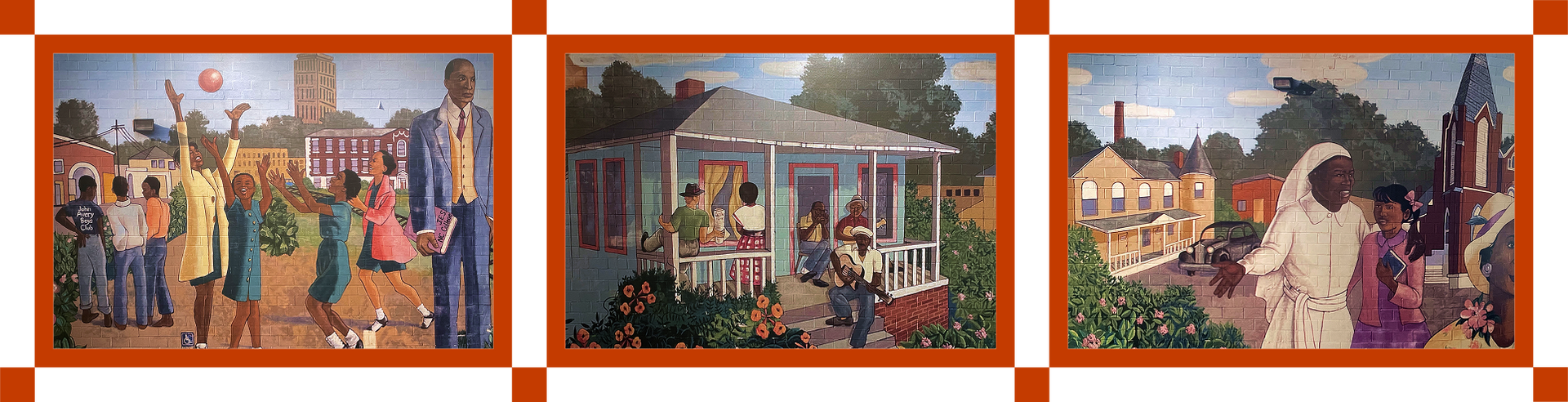
Hayti began as an act of imagination. Freed people, moved by the revolution unfolding in Haiti, came to Durham and built something that hadn't existed here before: a community of their own. Many settled near Old Fayetteville Road, drawn by work in the city's tobacco factories. Rented land became owned land, one parcel at a time, until renting itself became a memory.
That's how you build capital when no one hands it to you — on purpose.
Two churches anchored the neighborhood. St. Joseph AME, whose original sanctuary still stands today as the Hayti Heritage Center. And White Rock, whose first home at Mobile Avenue and Fayetteville Street was completed in 1896 — a corner now buried under the Durham Freeway. Pettigrew and Pine Streets marked Hayti's edges, while Parrish Street downtown grew into its financial heart, part of a wider constellation of Black-built economies that included Tulsa, Richmond's Jackson Ward, Rosewood, and Wilmington before the fires came.
Hayti's residents didn't wait for permission to build what they needed. A library. Private medical and legal practices. Funeral homes. Lincoln Hospital. Architecturally striking homes — some still standing, like the Scarborough House and the residence of F.W. Watkins, known around town as the Movie King. Booker T. Washington and W.E.B. Du Bois both took notice. And up and down the district's streets, the Regal Theater, the Wonderland Theater, the Biltmore Hotel, and the Do-Nut Shop gave Hayti its nightlife — and its name.

Landmarks
St. Joseph's AME Church
In 1868, Edian Markham — an AME missionary and formerly enslaved man — arrived in Durham. With five others, he purchased land from Minerva Fowler to start a church. The first sanctuary was a brush arbor: bushes lashed to poles, grassy earth for a floor. A log cabin came next. And on August 20, 1869, that six-member congregation made it official, organizing as Union Bethel AME Church.
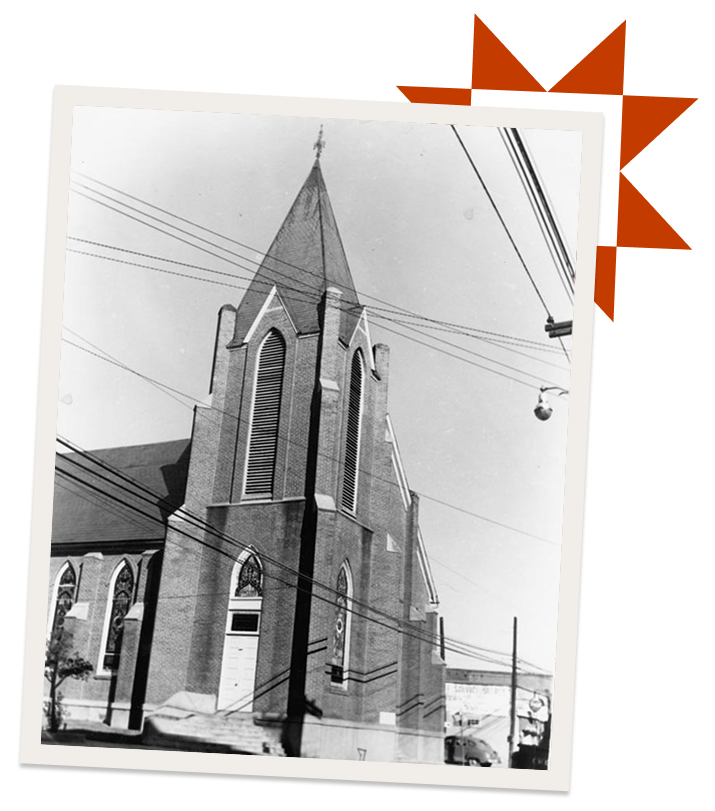
Under the pastors who followed, the congregation grew from log cabin to frame building to something built to last — a cornerstone laid in 1892 at 804 Fayetteville Street. It was around this time the church took the name it still carries: St. Joseph African Methodist Episcopal Church. Members and community leaders gave generously to raise it, among them John Merrick, co-founder of North Carolina Mutual Life Insurance Company, alongside Professor W.G. Pearson, Minnie S. Pearson, John Avery, and E.D. Mickle. White Durham citizens Washington Duke, General Julian Carr, W.T. Blackwell, and Eugene Morehead contributed as well, and their names remain etched into the sanctuary's stained glass — still catching the light today.
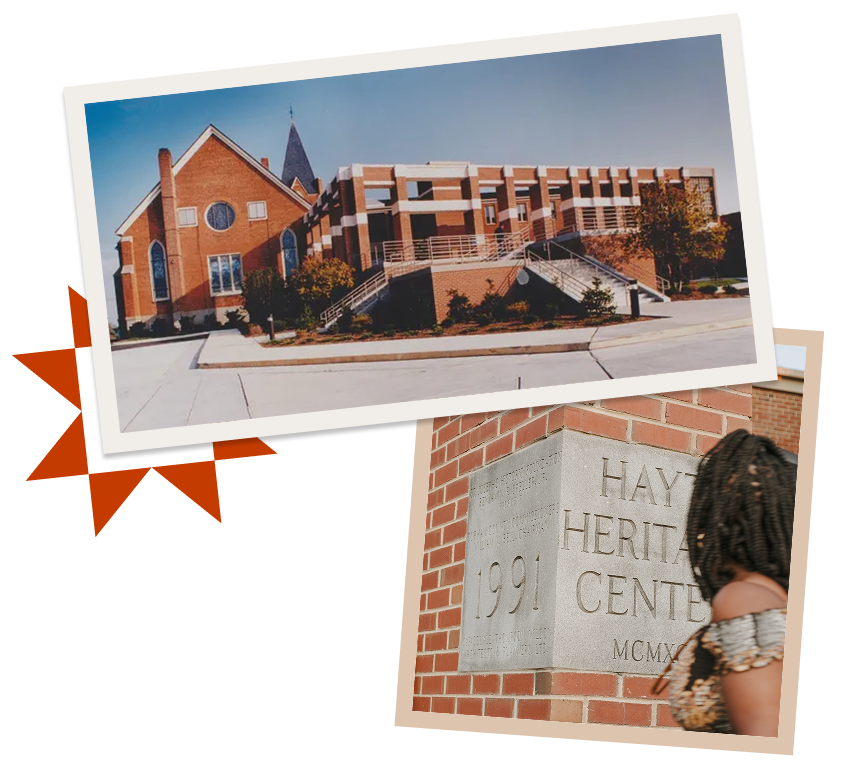
St. Joseph's Historic Foundation /
Hayti Heritage Center
By 1975, this building was slated for demolition. Lyda Moore Merrick and her daughter, Lyda Constance Merrick Watts, weren't willing to let that happen — not to a building this irreplaceable to Durham's Black Wall Street legacy. So they founded St. Joseph's Historic Foundation to save it. Their mission was never just about brick and mortar: it was to advance cultural understanding of the African American experience, locally, nationally, and globally, through programming that would keep this history alive — not shelve it as a footnote.
That mission is still what drives the preservation, restoration, and development of the Hayti Heritage Center, the former St. Joseph AME Church and now a National Historic Landmark. It shows up in cultural programming rooted in African American heritage, in educational work that connects Durham's story to the larger American one, in community engagement through the arts, and in endowment support for programs like the Center's dance initiatives.
Over the decades, leaders like Titus Heagin, Walter Norfleet, Dianne Pledger, and Darrell Stover carried that torch — building everything from youth art camps to the Black Diaspora Film Festival, bringing national speakers, plays, and concerts through these doors, helping launch one of the country's top spoken word teams, and hosting the internationally recognized Bull Durham Blues Festival.
The Hayti Model
What we're building now
For fifty years, St. Joseph's Historic Foundation has held onto this landmark and this legacy, keeping Hayti's memory alive even through the years when so much around it was lost.
Now we're asking a bigger question: Can Hayti do more than remember what was built and what was taken? Can it become living proof that a historic community can rebuild itself without pushing out the people and culture that made it worth investing in in the first place? We believe the answer is yes — and the Hayti Model is how we intend to prove it.
The idea is simple, even if the work isn't. Culture creates belonging. When people see their history and their identity reflected in a place, they feel connected to it. Belonging attracts investment, because people invest their time, their trust, and eventually their money in places where they feel they belong. Investment creates opportunity — jobs, businesses, education, real pathways for young people. And opportunity builds wealth: wealth that stays in the community, that gets passed down, that in turn preserves the very culture that started the cycle. Culture. Belonging. Investment. Opportunity. Back to culture again. Repeat that across generations, and that's what generational wealth actually looks like.
We're starting with what we already have. The Hayti Heritage Center still stands where it was built in 1891, on the same ground where this community first took root. Our youth programs, our film and gaming initiatives, our artist membership, our season of performances — these aren't separate activities. They're the early building blocks of something larger: proof that culture and community can grow together, rather than one being sacrificed for the other. The first generation built Hayti. The second generation preserved it. This generation gets to show the rest of the country what comes next.
The Hayti Model
What we're building now
For fifty years, St. Joseph's Historic Foundation has held onto this landmark and this legacy, keeping Hayti's memory alive even through the years when so much around it was lost.
Now we're asking a bigger question: Can Hayti do more than remember what was built and what was taken? Can it become living proof that a historic community can rebuild itself without pushing out the people and culture that made it worth investing in in the first place? We believe the answer is yes — and the Hayti Model is how we intend to prove it.
The idea is simple, even if the work isn't. Culture creates belonging. When people see their history and their identity reflected in a place, they feel connected to it. Belonging attracts investment, because people invest their time, their trust, and eventually their money in places where they feel they belong. Investment creates opportunity — jobs, businesses, education, real pathways for young people. And opportunity builds wealth: wealth that stays in the community, that gets passed down, that in turn preserves the very culture that started the cycle. Culture. Belonging. Investment. Opportunity. Back to culture again. Repeat that across generations, and that's what generational wealth actually looks like.
We're starting with what we already have. The Hayti Heritage Center still stands where it was built in 1891, on the same ground where this community first took root. Our youth programs, our film and gaming initiatives, our artist membership, our season of performances — these aren't separate activities. They're the early building blocks of something larger: proof that culture and community can grow together, rather than one being sacrificed for the other. The first generation built Hayti. The second generation preserved it. This generation gets to show the rest of the country what comes next.